

- Perspectives
Ask a CFO what they pay for payroll software and they'll tell you to the dollar. Ask what they pay Stripe and they'll quote the take rate from memory. Ask what they paid their bank to convert USD into EUR last quarter and you'll get a pause, then something like: "I don't think we pay anything. There's no fee on the statement."
That's exactly the point. There's no fee on the statement.
Currency conversion (FX) fees are one of the only costs in a modern business that aren’t priced as a line item. They are hidden inside the exchange rate itself - known as ‘the spread’ - so it never shows up as an expense, never gets flagged in a budget review and never triggers the procurement instinct that every other vendor cost does.
In almost every other market you operate in, the price is built in and visible: software is priced per seat, card processing is priced per transaction, brokers quote commission. FX is priced in silence.
And as it turns out, silence is expensive.
How FX pricing actually works
There are only two numbers you need to understand.
1. The mid-market rate
At any moment, there's a global market of banks buying and selling currencies to each other. The price they're willing to buy at and the price they're willing to sell at sit very close together, and the midpoint between them is the mid-market rate (sometimes this is called the interbank rate, or just the "real" rate). This is the number you see when you Google "USD to EUR". It moves in real time, is publicly observable and it's the rate the professionals use when they trade with each other.
2. The spread applied on top
Companies and individuals almost never get the mid-market rate. Whoever converts your money - a bank, a payment provider, a broker - applies a margin on top of it before quoting you. If mid-market is 0.9200 and you're quoted 0.9108, that 1% gap is the spread - the fee that the broker takes for converting funds. On a $2M transfer, that's $20,000 but it doesn't look like $20,000, because it's baked into the rate rather than itemized as a fee.
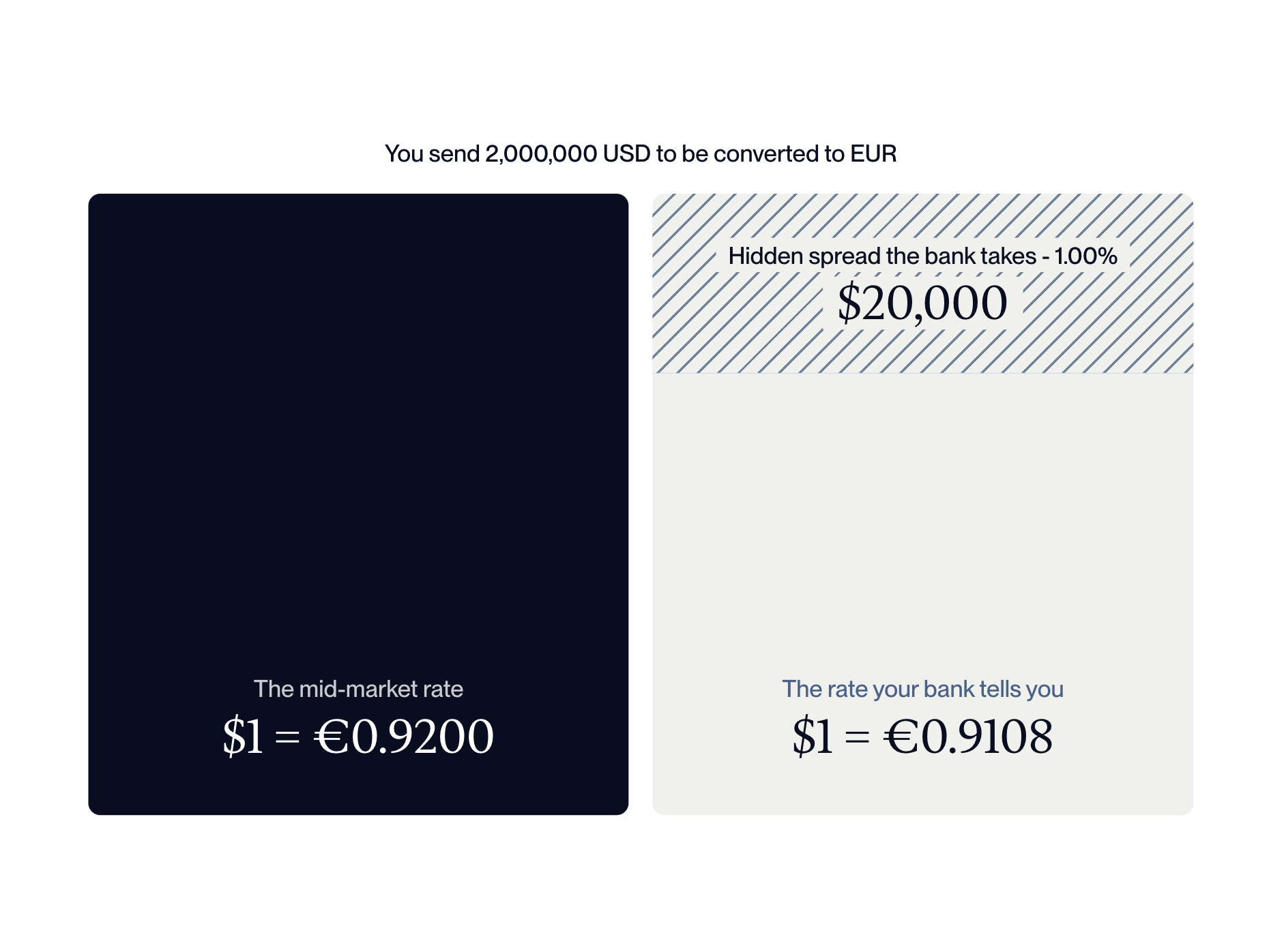
FX pricing breakdown
This is why "no fees on international payments" and "0% commission" are some of the most misleading phrases in finance. The wire fee was never the product. The spread is the product.
The quiet genius of the bank model
The dynamic of baking in fees means that FX spread is one of the core profit engines of commercial banking. It works because, unless you’ve seen the spread before, you don't know what you're being charged.
Banks don't publish their FX margins. The rate you get depends on who you are, how much you move and whether you've ever pushed back. Two companies moving the same amount on the same day through the same bank can get materially different rates and neither would ever know.
The mechanism holding it all together is trust. You trust your bank. They hold your deposits, they gave you your first operating account, your board knows the logo. So when a rate comes back on a conversion, nobody pulls up mid-market and does the subtraction. The relationship substitutes for the diligence.
That trust is rational in a lot of contexts. On FX pricing, it's a mistake. It’s a mistake that gets more expensive every year your international volume grows. You wouldn't accept "trust us" as pricing from any other vendor. Your bank's FX desk is currently the only exception because most teams don’t know how to see how much they’re being charged.
Why US finance teams never learned to look
There's a specific reason this blind spot is worse in the US than almost anywhere else. It’s because American companies never needed to care.
The world is denominated in USD. For decades, a US tech company could raise in dollars, hire in dollars, sell in dollars and IPO in dollars without a single currency conversion along the way. FX literacy simply never made it into the American finance playbook, because there was nothing to be literate about.
That era is over. The default company today is global from day one: engineering in Europe or LATAM, contractors on four continents, revenue landing in GBP + EUR + AUD, entities spinning up wherever the customers are. By Series B, almost every company has a real international dimension. By Series C or D, cross-border flows across payroll, vendor payments, intercompany funding and foreign revenue repatriation are a meaningful share of everything moving through the business.
Run the math on what that means. A Series C scale-up moving $50M a year across currencies is handing over millions for a service that costs the bank a fraction of that to provide. Across a few years of scaling, it compounds quietly, invisibly, with no line item anywhere. It's often more than the entire finance team's software budget, spent on nothing.
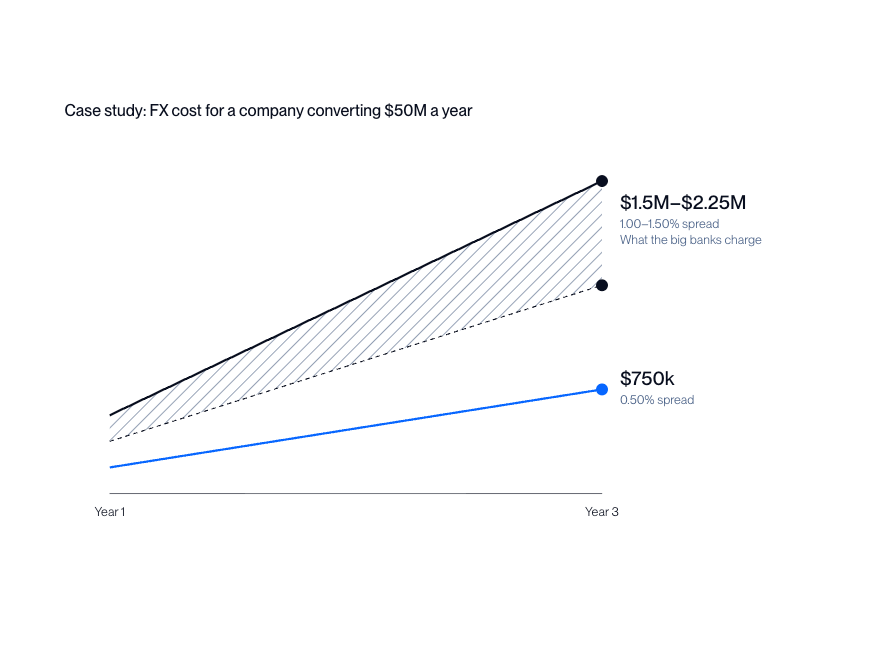
FX Cost Graph
The finance teams at these companies aren't careless, they're excellent! They just inherited a playbook written for a world where the money never left the country.
Transparency is the disruption
Whenever a market runs on obfuscation, the disruption is rarely a better product first. It's a visible price.
That's the shift we’re seeing in FX now. We’re part of a new cohort of challengers telling you the exact number. Primary quotes a transparent, fixed margin above the mid-market rate so that on every single conversion you can see exactly what you're paying and hold that number up against anyone else's.
Once the price is visible, the market works the way markets are supposed to. You can benchmark it. Your bank's spread stops being a trust exercise and starts being what it always was: a fee, one you can now actually compare.
The bottom line
Your FX cost isn't zero just because it's invisible. The mid-market rate is public; the gap between it and the rate you're getting is the real price you pay, and for most US scale-ups it's the largest vendor cost they've never reviewed.
So do the five-minute exercise, or get our team to do it for you for free. If the answer surprises you, you're in the majority and you're one conversation away from fixing it.
About Primary
Primary is agentic treasury for multi-national growth companies. Complete cash visibility, idle cash optimization and FX at transparent rates above mid-market - all in one platform.