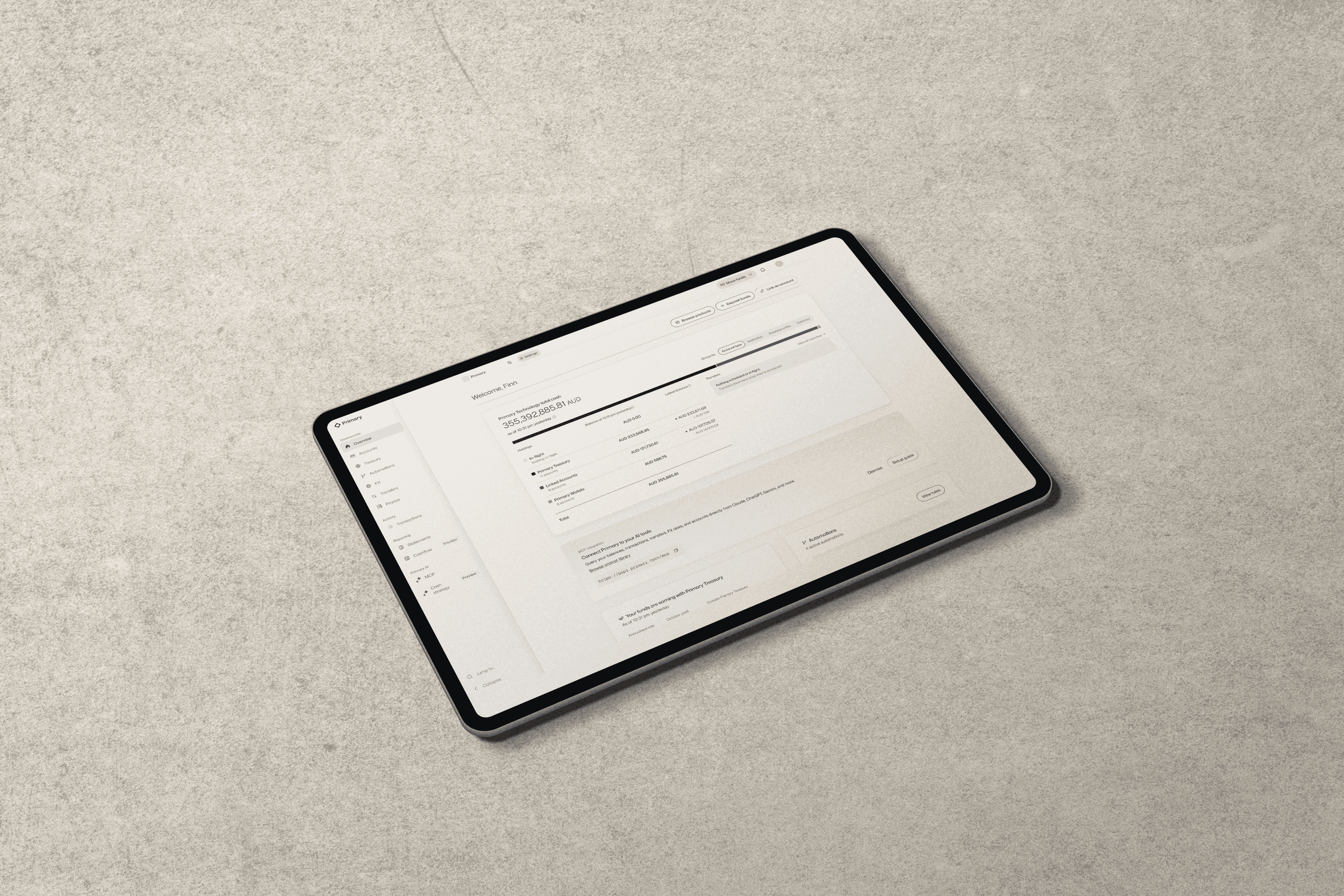

Keep the cash you need in the next month or two in your operating account. Put the rest in government money market funds or short-dated Treasury bills, held in your company's name, where it earns a market rate and can be back in your account within a day or two.
The choice between providers comes down to three things. What you earn after fees, how quickly you can get the money out and whether you have to move your banking to get it. Mercury, Rho and Meow offer yield to companies that bank with them. Primary works across the banks you already have.
Primary is our product. This guide is general information and not investment advice. Yields change daily and are not guaranteed.
The six options compared
| Option | Best for | What it costs |
|---|---|---|
| Your bank's savings or money market account | Smaller balances you want covered by deposit insurance | No fee. The rate is usually below what funds pay |
| Mercury Treasury | Companies that already bank with Mercury | Fee of 0.15% to 0.60% a year, based on total deposits |
| Rho Treasury | Companies that run their banking and spend on Rho | Fee of 0.15% to 0.60% a year, based on balance |
| Meow | Companies that want to buy Treasury bills directly | Yields are quoted net of Meow's fee |
| Buying Treasury bills through a broker | Teams with the time to manage it themselves | Brokerage fees, plus the time to run it |
| Primary | Growth-stage companies with cash spread across several banks and currencies | A service fee on the balance earning yield. Platform plan from $399 a month |
Your bank's savings or money market account
Best for: Smaller balances you want covered by deposit insurance. Cost: No fee. The rate is usually below what funds pay.
The simplest option is the interest-bearing account your bank already offers. The money stays a deposit, so it is covered by FDIC insurance up to the standard limit.
Rates are tiered by balance. SVB's startup money market account, for example, was listed at 3.30% on balances over $1 million and 0.10% on balances up to $50,000 in a provider comparison published by Rho.
It is easy and it is safe. On a large balance the gap to a money market fund adds up.
Mercury Treasury
Best for: Companies that already bank with Mercury. Cost: Fee of 0.15% to 0.60% a year, based on total deposits.
Mercury Treasury invests your cash in a government money market fund or an ultra-short bond fund. It advertised net yields of up to about 3.6% at the time of writing.
You need at least $250,000 across your Mercury accounts and it is only open to Mercury customers. The money market option offers same-day access.
It is a good fit if Mercury is your main bank. It does not help with cash you hold elsewhere.
Rho Treasury
Best for: Companies that run their banking and spend on Rho. Cost: Fee of 0.15% to 0.60% a year, based on balance.
Rho Treasury is run by a registered investment adviser. You choose an allocation across Treasury bills, a money market fund and an ultra-short income fund.
The fee is tiered. It is 0.60% on balances under $2 million and falls to 0.15% at $20 million and above. The balance used to set your tier includes your Rho checking account.
As with Mercury, it works best when Rho is where you bank.
Meow
Best for: Companies that want to buy Treasury bills directly. Cost: Yields are quoted net of Meow's fee.
Meow gives businesses direct access to US Treasury bills through a registered investment adviser. It also offers UK gilts and German bunds for companies holding other currencies.
It generally requires $100,000 in a Meow checking account to use its yield products.
It suits teams that want to own the bills themselves and are comfortable choosing maturities.
Buying Treasury bills through a broker
Best for: Teams with the time to manage it themselves. Cost: Brokerage fees, plus the time to run it.
You can open a brokerage account for the company and buy Treasury bills yourself. They are backed by the US government and come in maturities from four to 52 weeks.
You keep all of the yield. You also take on the work of choosing maturities, reinvesting when bills mature and making sure cash is available when the business needs it.
Primary
Best for: Growth-stage companies with cash spread across several banks and currencies. Cost: A service fee on the balance earning yield. Platform plan from $399 a month.
Primary lets you earn yield without moving your banking. It connects to the banks you already use and places idle cash with providers including BlackRock and Morgan Stanley, in accounts held in your company's name.
It targets up to 4.5% a year on USD, depending on balance. It also offers rates on AUD, GBP and EUR. You set rules for how much stays in each operating account and the rest is swept to earn.
If all your cash sits with one neobank that already offers a fund, the built-in option is simpler. Primary fits once cash is spread across banks, entities or currencies.
How to choose
Start with how much you can set aside. Work out what you spend in a typical month, keep one to two months in your operating account and treat the rest as cash that can earn.
Compare what you keep after fees. Most providers quote a net yield, so check the fee tier for your balance and not the headline rate.
Check how the money is protected. A bank deposit is covered by FDIC insurance up to a limit. Money market funds and Treasury bills are securities, which are covered by SIPC against a broker failing and not against a fall in value.
Check who holds it and how fast you can get it back. Prefer accounts in your company's name with access within a day or two.
What to do after a funding round
- Agree a simple written policy with your board. Say what you can invest in, the longest maturity you will hold and how much stays in operating accounts.
- Keep the next one to two months of spend in your operating account.
- Put the next six to twelve months in a government money market fund or short Treasury bills so it stays liquid.
- Only consider anything longer dated for cash you are sure you will not need for a year or more.
- Review it each quarter as your burn and the rates change.
Common questions
Where should my company keep its cash to earn yield?
Keep one to two months of spend in your operating account and hold the rest in government money market funds or short-dated Treasury bills in your company's name. They pay a market rate and can usually be turned back into cash within a day or two.
Where is the best place to put cash after a funding round?
Split it by when you need it. Near-term spend stays in the operating account. The next six to twelve months goes into a government money market fund or Treasury bills. Write the approach down as a short policy your board has agreed.
How do I earn more interest on company cash?
Move idle balances out of checking and into a money market fund or Treasury bills. Compare providers on the yield after fees. If your cash is spread across banks, use a tool that sweeps the excess from each account automatically.
Is my company's cash earning enough?
Compare what you earn with the current yield on a government money market fund or a 13-week Treasury bill. If most of your cash sits in checking earning close to nothing, you are giving up that difference.
Sources
- Mercury Treasury
- Mercury Treasury disclosures
- Rho Treasury
- Rho's provider yield comparison
- Meow treasury
- Primary pricing
Pricing was checked on November 19, 2026 and changes often. Confirm current rates with each provider.